About / the workshop
Hand turned in Canada
Split by hand. Turned to order.
Every Crown bat begins as one billet of Canadian hard maple or yellow birch, and is finished for the player who ordered it.

Split
Straight grain, end to end.
Every Crown bat starts as a log split by hand. Where a saw cuts its own line, splitting follows the wood's natural fibre path, revealing how the grain truly travels through the log. Only billets whose grain runs straight and continuous from end to end go on to become bats.
See the four splitting steps
- 1. Select the log
- A sound, straight section of hard maple or yellow birch, with minimal sweep and clear of knots, decay, and scars. The ends are examined for centred growth, consistent rings, and cracks.
- 2. Read the grain
- Checks, bark, knots, and the direction of the fibres plan each split. The aim is to follow the grain rather than force the wood into a predetermined sawn line.
- 3. Inspect each billet
- Every freshly exposed face is examined for grain runout, knots, bark inclusions, cracks, and mineral streaks. Only clean, straight billets go forward.
- 4. Trim and protect
- Accepted billets are trimmed to consistent dimensions. Where needed, their ends are sealed to slow moisture loss and guard against end checking, then the billets are stacked for drying.
The result is a billet whose fibres remain aligned from end to end. The maker sees the grain clearly before turning, every billet is consistent with the last, and the strength of the wood runs the full length of your bat.
Dried
Dried to the core, for more pop.
Each billet is then vacuum kiln dried: a controlled method for bringing wood to its working moisture content before turning, machining, and finishing. It is the gold standard in modern bat production. Under vacuum, water leaves the wood at a lower temperature, so each billet dries gently and evenly, right to its core. In stress tests, finished bats dried this way show greater pop and flex further under load.
See the five kiln advantages
- Lower drying temperatures
- Water evaporates at a lower temperature under vacuum, so the wood fibre is spared prolonged heat.
- Colour retention
- Low heat and little oxygen help light woods such as hard maple resist darkening and oxidation, so they stay clean and bright.
- Even moisture gradients
- Properly controlled, the vacuum draws moisture steadily from the billet core, for a uniform final moisture content throughout.
- Dimensional stability
- Short, controlled cycles under load restraint hold billets against warp, so they stay straight and stable for turning.
- Clean drying
- A well-designed schedule keeps surface and core sound, free of surface checking and casehardening.
Turned
Turned when you order.
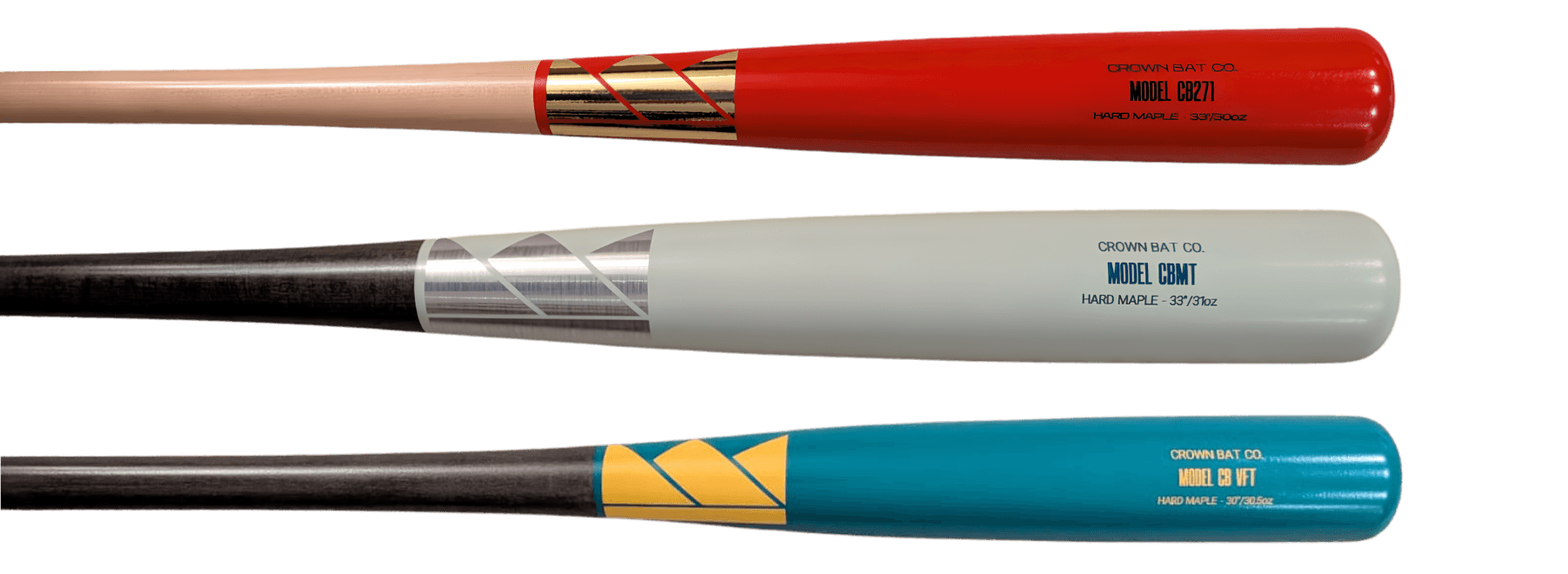
Each bat is turned when it is ordered, then finished and stamped with its model, length, and weight.